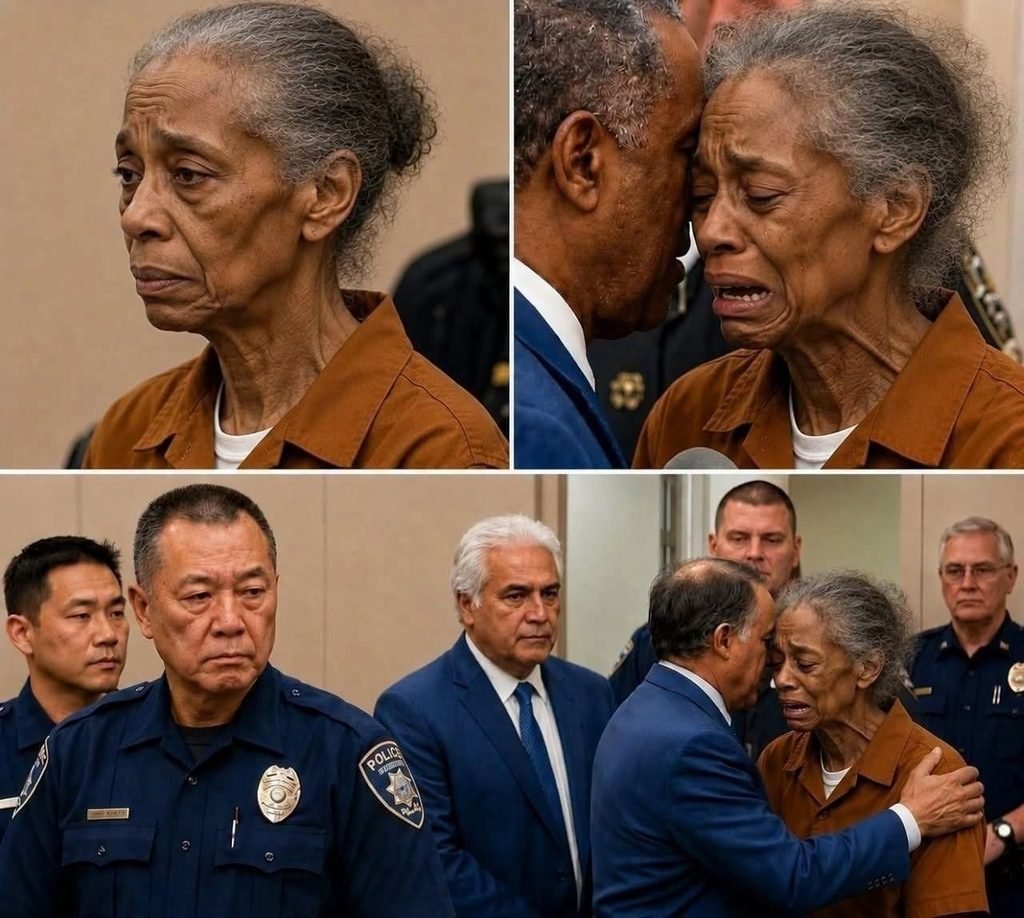
A headline such as “Old Woman Sentenced to 150 Years in Prison After She Ra…” is almost impossible to scroll past. It immediately raises questions: Who was she? What could possibly have happened to result in a sentence of 150 years? Was the woman actually elderly? Was the sentence really 150 years, or is the headline leaving out an important detail?
These questions matter because dramatic crime headlines circulating online are sometimes shortened, rewritten, or stripped of context to encourage readers to click. There are documented cases involving extraordinarily long prison sentences, but the details can be very different from what a sensational headline initially suggests.
One particularly important case involved Aariel Maynor, who was sentenced in California in 2022 to 150 years to life for the killing of 81-year-old philanthropist Jacqueline Avant. The person receiving the sentence was not an old woman; Maynor was a young man.
The Case of Jacqueline Avant
Jacqueline Avant was a highly respected philanthropist and community leader who was 81 years old when she was killed at her Beverly Hills home on December 1, 2021. She was also the wife of legendary music executive Clarence Avant, a prominent figure in the American entertainment industry.
According to prosecutors and court records reported by the Los Angeles Times, Maynor entered the couple’s home during a burglary. Avant confronted him, and he fatally shot her. As he fled, he also fired several shots toward an unarmed security guard, although the guard was not injured.
The crime shocked the community. Avant was not simply known as the wife of a famous music executive. She had spent years involved in community and philanthropic work, including serving as president of the Neighborhood of Watts, a support organization connected with child care in South Los Angeles.
Who Was Sentenced to 150 Years?
The person sentenced was Aariel Maynor, not Jacqueline Avant and not an elderly woman.
According to reporting from the Los Angeles Times, Maynor was 29 at the time of sentencing and had a criminal history that included previous robbery convictions. He had been released from state prison only a few months before Avant’s killing.
He ultimately pleaded guilty to several charges, including premeditated murder, attempted murder, being a felon in possession of a firearm, and two counts of residential burglary.
The court imposed a sentence of 150 years to life for the murder, along with additional consecutive time for other crimes. The result was effectively a sentence designed to keep Maynor in prison for the remainder of his natural life.
Why Was the Sentence So Long?
A sentence of 150 years sounds almost impossible at first glance. After all, no ordinary human being is likely to live long enough to physically serve 150 years.
However, extremely long sentences can arise because courts impose separate sentences for different offenses, enhancements, and consecutive terms. In Maynor’s case, the sentence was connected to the murder, his prior convictions, and additional crimes committed during the incident.
The Los Angeles Times reported that the judge imposed 150 years to life for the murder with three-strikes enhancements, followed by another 40 years for other crimes.
What Does “150 Years to Life” Actually Mean?
This phrase is important.
A sentence such as “150 years to life” is not necessarily the same thing as simply saying someone received an ordinary 150-year prison sentence. The wording reflects the structure of the sentence under the applicable law.
In practical terms, however, a sentence of this magnitude can mean that the defendant will spend the rest of their life incarcerated.
This is why a headline saying “150 years in prison” can be technically understandable while still leaving out important legal context.
The Tragedy Behind the Headline
It is easy for a sensational headline to turn a human tragedy into a curiosity.
But at the center of this case was an 81-year-old woman whose life was abruptly ended. Jacqueline Avant had spent decades building relationships and contributing to her community.
Her husband, Clarence Avant, was one of the most influential figures in the music industry. Jacqueline’s own identity, however, was not simply an extension of her husband’s fame. Her community work was an important part of her legacy.
Her daughter, Nicole Avant, described the family’s condition after the killing in a letter read before sentencing, saying that the family was shattered by the loss.
What Happened During the Burglary?
According to prosecutors, Maynor planned the burglary before arriving at the Avant residence. The Los Angeles Times reported that he had researched homeownership records connected with Clarence Avant before the crime and approached the house carrying an AR-15-style rifle.
Security footage reportedly captured him approaching the property. Inside the house, he encountered Jacqueline Avant. She was unarmed. According to the sentencing information reported by the Los Angeles Times, Maynor shot her in the back before fleeing.
As he escaped, he fired several rounds toward a security guard, who survived. Investigators also said Maynor subsequently attempted another burglary.
The Second Burglary and His Arrest
After leaving the Avant residence, Maynor reportedly went to another home in the Hollywood Hills and attempted to break into that residence as well.
His escape eventually came to an end when police located him in the backyard of that property. According to the newspaper’s account, he had shot himself in the foot with the same rifle. Investigators also recovered evidence that helped connect him to the crimes, including a red glove he reportedly dropped while fleeing.
The Jailhouse Recording
One of the most disturbing elements discussed during sentencing involved a telephone call Maynor made from jail.
According to the Los Angeles Times, prosecutors played a recording in court in which Maynor talked to a female acquaintance about the killing and the publicity surrounding it. The newspaper reported that he laughed during the conversation and talked about appearing in the news.
Such evidence can have a powerful effect during sentencing because courts may consider the defendant’s history, conduct, criminal record, and other legally relevant circumstances.
His Previous Criminal History Mattered
The sentence did not occur in a vacuum.
According to the Los Angeles Times, Maynor had previous convictions for robbery and causing great bodily injury. One earlier robbery conviction involved an attack on a woman in Hollywood, while another robbery case occurred in 2018.
The existence of prior convictions became important because prosecutors sought to apply California’s repeat-offender sentencing provisions. That was one reason the final punishment was dramatically longer than a sentence based solely on the murder charge might otherwise have been.
The Role of California’s “Three Strikes” Rules
California has historically had particularly severe sentencing provisions for people with qualifying prior serious or violent convictions. These are commonly associated with the state’s Three Strikes law.
In Maynor’s case, prosecutors sought enhancements based on his previous convictions. The Los Angeles Times reported that prosecutors wanted to ensure he would not qualify for early release and argued that his criminal history showed he posed a serious danger.
The sentencing debate therefore involved more than simply determining punishment for one terrible night. It also involved how the criminal justice system should respond to someone with previous violent convictions who commits another extremely serious offense.
The Defense Asked the Judge to Consider His Background
Maynor’s attorney argued that the court should consider his background and asked the judge to remove the prior strikes that increased the sentence.
The judge declined to do so. According to the Los Angeles Times, the judge emphasized the violent nature of Maynor’s previous crimes and found insufficient evidence that he had made positive changes while incarcerated.
This illustrates an important part of criminal sentencing: courts can consider both the specific offense and the defendant’s broader history.
Why Such Sentences Attract Attention
A sentence of 150 years is emotionally striking. It sounds almost surreal.
People naturally ask: Why give someone 150 years when they’ll never live that long?
Extremely long sentences can reflect multiple convictions, account for sentencing enhancements, ensure that separate offenses receive separate punishment, prevent or restrict the possibility of early release, reflect the seriousness of the conduct, and protect the public from a person considered dangerous.
The exact legal effect depends on the jurisdiction and the structure of the sentence. In this case, the enormous sentence was intended to keep Maynor imprisoned for the remainder of his life.
The Phrase “Old Woman” Changes the Story
This is where viral headlines can become misleading.
Imagine seeing: “Old woman sentenced to 150 years in prison after she ra…”
Most readers will naturally assume that the woman herself committed some extraordinary crime. But the documented Jacqueline Avant case tells a completely different story.
An 81-year-old woman was the victim. The person sentenced to 150 years was a much younger man.
That distinction demonstrates why readers should never rely on an incomplete headline when the story involves a serious crime.
Why Social Media Headlines Leave Out Details
Modern online headlines compete for attention.
A straightforward headline might say:
“Man Sentenced to 150 Years to Life for Killing Philanthropist Jacqueline Avant.”
That is factual but relatively long.
A social-media account may instead create a mysterious headline such as:
“Old Woman Sentenced to 150 Years After She Ra… See More.”
The second version creates a curiosity gap. Readers want to know what happened. They click, comment, and share.
But the shorter headline may also create confusion. This is why responsible readers should distinguish between the headline’s wording and the underlying reporting.
The Danger of Filling in Missing Information
When a headline ends with “After she ra…”, our brains automatically try to complete the sentence.
Maybe she robbed someone. Maybe she ran from police. Maybe she committed fraud. Maybe she attacked someone.
The possibilities are endless.
But until the actual article provides the missing information, none of those assumptions are justified.
Whenever you encounter a dramatic headline that deliberately withholds the conclusion, resist the temptation to invent the ending yourself. Read the full story, look for the original reporting, check the date, identify the location, and determine whether the headline is describing the defendant or the victim.
The Human Cost of Violent Crime
The Avant case also reminds us that crime statistics can obscure individual suffering.
A murder statistic might be presented as one number. But for a family, that number represents a person.
Jacqueline Avant was a mother, wife, friend, and community leader. Her death changed her family’s life permanently. Her daughter later spoke publicly about the devastation caused by the killing.
For communities, high-profile crimes can also create fear. The Avant killing became part of a larger public discussion about burglary, violent crime, repeat offenders, and public safety.
What Can We Learn From the Case?
There are several lessons worth taking away.
First, verify sensational headlines. A dramatic headline isn’t necessarily a complete account.
Second, identify the people correctly. Victims and defendants should never be confused.
Third, understand the legal terminology. “150 years to life” has a specific legal context and isn’t simply an ordinary 150-year sentence.
Fourth, look at the defendant’s history. Prior convictions can dramatically affect sentencing.
Fifth, remember the victims. Crime stories are not entertainment for the people whose families have been affected.
The Importance of Reliable Sources
When a story involves murder, sentencing, or allegations of criminal behavior, reliable sourcing matters.
The Los Angeles Times provided detailed reporting on Maynor’s sentencing, the evidence discussed in court, his criminal history, and the family’s response. UPI also reported on the sentencing and the practical effect of the sentence.
These kinds of sources are much more useful than an anonymous social-media post that provides only a dramatic photograph and an incomplete headline.
If you encounter a similar viral story, look for court records, police statements, prosecutors’ offices, established newspapers, reputable broadcasters, and multiple independent reports. The more serious the allegation, the more important verification becomes.
A Story Worth Reading Beyond the Headline
The phrase “150 years in prison” immediately captures attention. But the number alone doesn’t tell the story.
The story is about an elderly woman whose life ended during a violent burglary. It is about a family losing someone they loved. It is about a defendant with a history of violent offenses returning to prison after committing another devastating crime.
It is about the criminal justice system imposing an extraordinarily long sentence after a murder, attempted murder, and burglary. And it is also about how easily a complicated case can become distorted when reduced to a few sensational words.
Final Thoughts
If you came across a post saying “Old Woman Sentenced to 150 Years in Prison After She Ra… See More,” be careful about accepting the headline at face value.
One well-documented case involving a 150-year sentence concerned Aariel Maynor, who was sentenced after pleading guilty to the murder of 81-year-old philanthropist Jacqueline Avant, along with other crimes. Maynor was not an elderly woman; he was a young man.
The sentence reflected the seriousness of the murder, the additional offenses, and his previous criminal convictions.
The most important lesson isn’t simply that someone received an extraordinary prison term. It’s that context matters.
Before sharing a shocking crime headline, find out who was actually sentenced, who the victim was, what the defendant was convicted of, and how the sentence was legally calculated.
A sensational headline may get your attention in seconds—but the full story can be very different.
