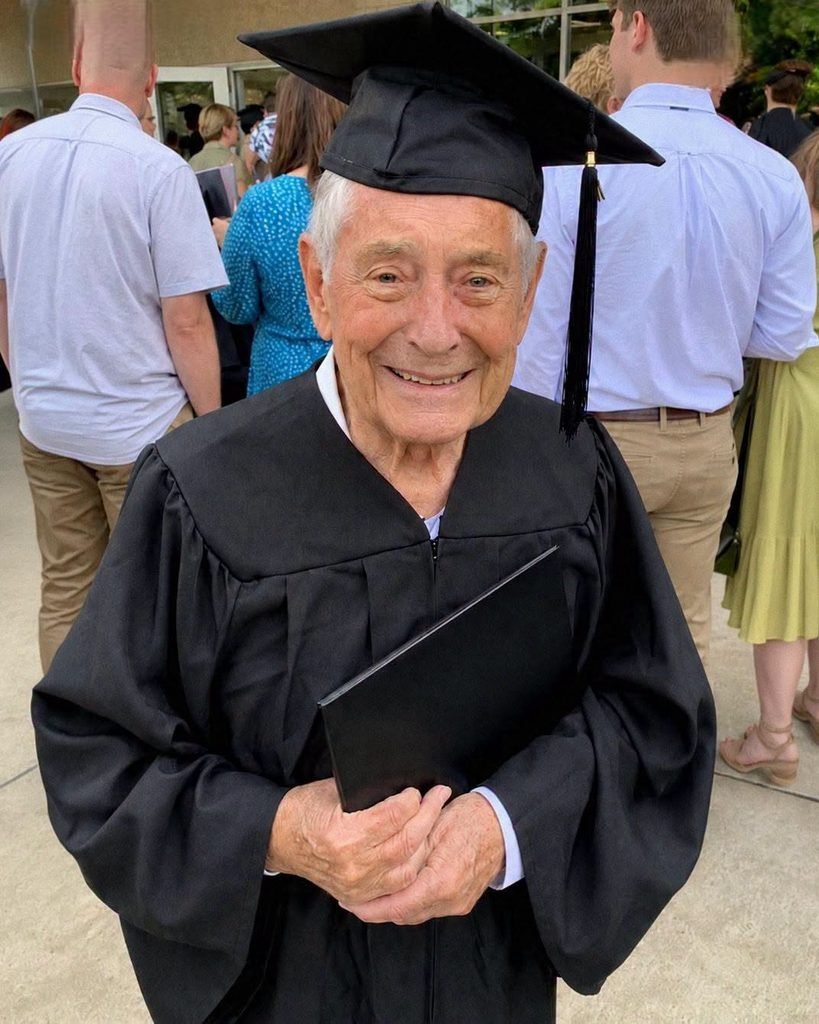
I nearly hit the truck in my driveway. Its rear doors were wide open, and two men were carrying things through my front door. Then I saw my sons, David and Ryan, standing on my lawn with a clipboard. Neither of them had called me in years. Yet on the happiest day I’d had in decades—the day I graduated from college at 68—they were suddenly standing outside my home with strangers. “What are you doing here?” I demanded. David looked uncomfortable. “Dad.” “Don’t ‘Dad’ me. Why is that man taking things out of my house?” Ryan quickly explained that they were bringing things in and moving furniture around. Inside, my living room was barely recognizable. Chairs were missing, boxes filled the hallway, and even the photographs on my mantel had been removed. Then I noticed a folder with my name on it. I opened it and felt my stomach drop: property valuation papers, photographs of my house, repair estimates, and figures showing what the property was worth. After years of silence, my sons had returned—and my first thought was that they were finally coming for my money.
Years earlier, when my wife Margaret died, the house became unbearably quiet. For decades, she had filled it with music, laughter, and life. After she was gone, I struggled to find a reason to get out of bed. Then one day I saw an advertisement for university enrollment. The idea sounded ridiculous at first, but it quickly became something I desperately wanted. I told my sons I was going back to school. David stared at me as if I had lost my mind. “You’re in your sixties,” he said. Ryan asked why I would spend my retirement savings on a degree I might never use. I told them I wasn’t doing it for a career. I simply wanted to learn. But they saw my savings differently. “What about us?” Ryan asked. “The family? The grandchildren? The future?” I looked at him and said, “My future is still happening.” That was the argument they never forgave me for. They called me reckless, irrational, and foolish. Eventually, the calls stopped. Birthdays passed without a word. Christmas came and went. My own sons disappeared from my life because I chose to spend my money and time on myself.
University wasn’t easy. Some students stared when I walked into lecture halls. One young man even asked if I was someone’s grandfather waiting for class to finish. “I am someone’s grandfather,” I told him. “I’m also in this class.” Studying took longer than it once would have. I sometimes read the same material three times before it stayed in my mind. Exams terrified me, and there were nights when I sat at the kitchen table surrounded by papers wondering what I was trying to prove. Then I would look at Margaret’s photograph and remember what she used to tell me: there is a difference between being alive and actually living. So I kept going. Years later, I finally walked across the graduation stage and accepted my degree. People applauded, and for those few seconds, I forgot my age, the people who had laughed, and the empty seats where my family could have been. I looked toward the ceiling and whispered, “I did it.” I hoped Margaret was somewhere watching.
I drove home expecting nothing more than a quiet drink and dinner alone. Instead, my estranged sons were inside my house, surrounded by boxes, tables, serving trays, and decorations. I held up the property valuation. “So this is why you’re here. You couldn’t wait, could you? Years ago, you were furious because I was spending your inheritance. Now you’re calculating what my house is worth?” David shook his head. “Dad, we’re not selling your house.” He explained that they had ordered the valuation because they wanted to know what repairs the house needed and how much it would cost to help me fix them. The roof, back steps, and downstairs bathroom all needed work. “Then why today?” I asked. David took a breath. “Because your graduation wasn’t the reason we came to repair the house. We came to celebrate you.” I stared at him in disbelief. They had known about my graduation for months. They had even contacted people from my university and prepared a party.
Then came the truth I had waited years to hear. David admitted they had been following my progress since my second year. They knew about my classes, my exams, and my accomplishments. They had even attended my graduation and sat quietly in the back. “Why didn’t you come to me?” I asked. Ryan lowered his eyes. “We didn’t know if you’d want us there.” David finally admitted what I had always suspected. “We thought of your savings as family money. We shouldn’t have, but we did.” Ryan nodded. “When you spent it on school, we acted like you were taking something from us.” I looked at them and asked, “So you abandoned me because you thought I was wasting your inheritance?” David’s eyes filled with tears. They had expected me to quit after one semester. When I didn’t, they became embarrassed because every semester proved them wrong. Instead of admitting it, they stayed away.
I told them exactly what their absence had cost me. “You could have called. You could have come to one birthday. One Christmas. One ordinary Tuesday.” David whispered, “I know.” I told them there had been nights when I wondered if I was a pathetic old man pretending to be young. But university had given me something I desperately needed after Margaret died: a reason to wake up. Ryan quietly said, “A reason to live.” I nodded. “Yes.” Then David said the words I had needed to hear for years: “We were wrong. About the money. About school. About you.” He admitted that my savings had never belonged to them and that I never owed them a larger inheritance at the cost of living my own life. Ryan stepped closer and said, “If spending your savings on university made you feel alive again, then that’s what the money was for.” For the first time, they understood.
The front door opened, and one of my classmates walked in carrying a cake. Behind him were more classmates, professors, balloons, and a huge congratulations sign. My sons had secretly organized a graduation party for me. Suddenly, the missing furniture, boxes, tables, and decorations made sense. My classmates hugged me, my professors congratulated me, and someone placed my graduation cap back on my head. For once, I didn’t feel like the old man in the room. I felt like a graduate. Later, I found my sons outside. “We’re not fixed,” I told them. David nodded. “I know.” “This doesn’t erase the years.” “We know.” I looked at them and said, “But maybe we stop wasting more of them.” Ryan smiled. “I’d like that.” We raised our glasses toward the evening sky. “To Margaret.” “To Mom,” they replied.
At 68, I wasn’t beginning a thirty-year career, and that had never been the point. My degree had already given me something more valuable than a job: it had given me a reason to wake up and keep living. My savings were mine to spend. My time was mine to use. Whatever remained after I had finished living my life could become an inheritance, but I was not an inheritance while I was still alive. David eventually asked, “So, what are you going to do now?” I smiled and said, “For once, I have no idea.” Ryan laughed. “That sounds expensive.” I raised an eyebrow. “Too soon?” “Much too soon.” We laughed together. I had spent years proving that 68 was not too old to learn. That night, my sons finally learned something too: when the people you love treat your life, money, and choices as if they already belong to them, you don’t have to sacrifice your happiness just to keep the peace. Sometimes, the bravest thing you can do is choose to keep living on your own terms.
